ᒥᔅᑯᒦ ᐋ ᓈᓂᑑᒋᔅᒑᐄᒪᑭᓂᐎᒡ / Ice Cover
Ice is an important component of Eeyou land use, particularly for snowmobile travel and hunting.
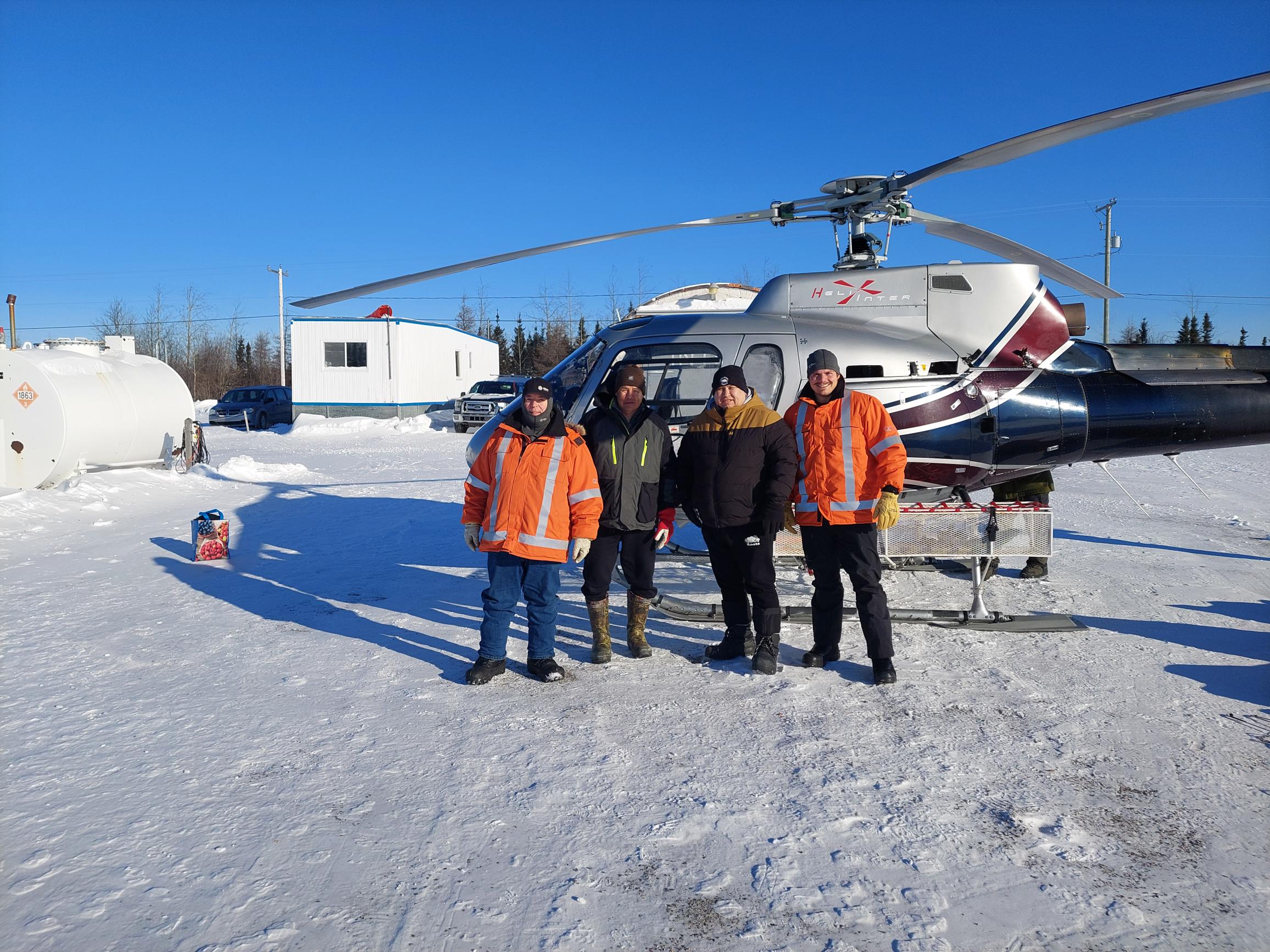
From January to April 2025, Chisasibi community members joined the technical team to conduct ice and thermal regime field studies. Five Chisasibi Eeyou participated in the field program, assisting with the January field campaign, March aerial surveys, and additional aerial surveys and sampling activities in April.
In early April 2025, a workshop was done to gather Eeyou knowledge on ice. The discussions at the workshop brought valuable insight on winter and spring ice conditions and the river crossings used by caribou during the winter, contributing to a better understanding of seasonal wildlife movements and land use. In January, March and April 2026, Chisasibi Eeyou joined the ice study campaign, conducting multiple flyovers covering samplings from La Grande-1 to La Grande-4.
Results of Environmental Surveys
Considering the conditions described below, no significant changes to ice formation are expected as a result of the potential capacity upgrades, and ice cover is expected to remain safe for travel. Overall ice thickness is expected to remain similar to current conditions. However, ice may become thinner in a few areas near water intake structures, where water moves faster, and near the upper area of reservoirs. During late spring, ice is expected to thin and weaken as it normally does. No changes are expected in the way ice breaks or deteriorates.
La Grande-4 and La Grande-3
Upstream of the La Grande 4 and La Grande 3 reservoirs, water levels could be lower than under current winter conditions, declining more rapidly until late February and then more gradually through March and April. The ice edge could be slightly farther from shore, exposing some rocks and small islands.
Downstream of La Grande-4 and La Grande-3, water flow could increase in certain locations, resulting in higher water speed, especially in January when power demand peaks. In these unsafe areas, existing open water and thin ice could extend over a larger area and persist for longer periods.
Robert-Bourassa (La Grande-2) / La Grande-1
At Robert-Bourassa (La Grande-2), water levels could decrease more slowly during January and February, resulting in slightly higher water levels by the end of February compared to current conditions. During this time, the ice edge could be closer to shore. Water levels could then decrease more quickly in March and April.
Ice conditions are not expected to change significantly as a result of the capacity upgrades in the La Grande 1 reservoir, on the Chisasibi (river), also known as the Grande Rivière, and its estuary.
Download the Factsheet on Ice Cover.
Change to ice cover are expected as a result of climate change. For more information, refer to the Climate Change fact sheet.


Merci pour votre contribution!
Aidez-nous à atteindre un plus grand nombre de personnes dans la communauté
Partagez-le avec votre famille et vos amis